
Most of us learned the rules of the road once, passed a test, and never looked at the handbook again. But plenty of everyday crashes and tickets come down to simple rules that drivers forgot, or never fully understood.
Whether you’re a brand-new driver, visiting from another country, or just want a refresher, here’s a plain-English guide to the rules that matter most on American roads.
One thing to keep in mind: traffic laws are set by each state, so details can vary. When in doubt, check your state’s driver handbook.
The Basics
In the U.S., you drive on the right side of the road and pass on the left. The steering wheel is on the left side of the car.
Everyone in the car should be buckled up. Seat belt laws cover drivers and front-seat passengers in nearly every state, and many states require back-seat passengers to buckle up too. Young children need a car seat or booster seat that fits their age and size, and the exact rules depend on your state.
What the Lines on the Road Mean
Lane lines aren’t decoration. They tell you where you can and can’t go.
- White lines separate lanes going the same direction. A broken white line means you can change lanes when it’s safe. A solid white line means stay in your lane.
- Yellow lines separate traffic going in opposite directions. A broken yellow line on your side means you can pass when the way is clear. A solid yellow line on your side means no passing.
- Double solid yellow lines mean no passing from either direction.
Who Goes First: Right of Way
Right-of-way rules decide who goes first, and they cause a lot of confusion.
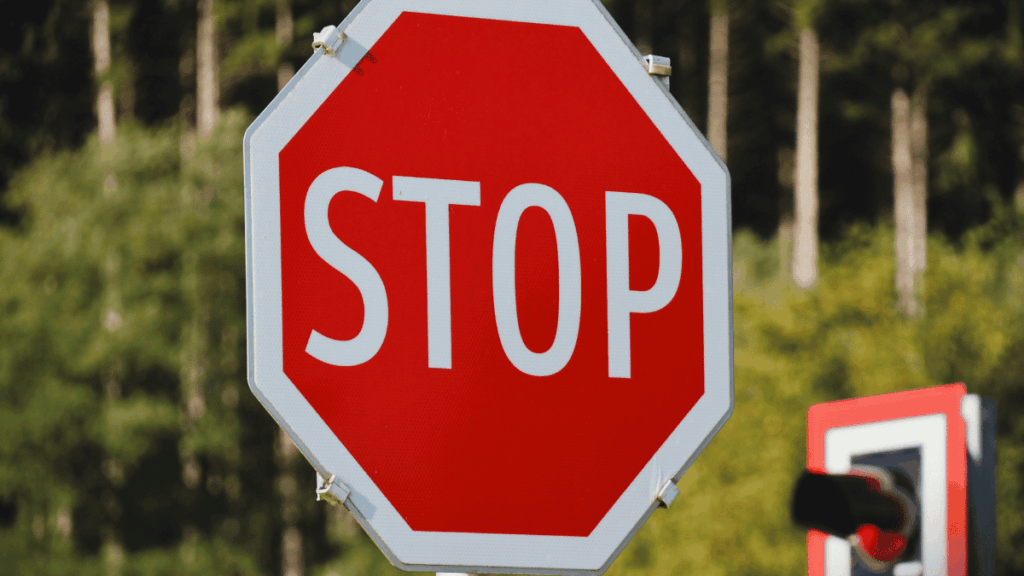
At a four-way stop, the first car to come to a complete stop goes first. If two cars stop at the same time, the car on the right goes first.
At an uncontrolled intersection with no signs or signals, slow down and yield to any car already in the intersection, and to the car on your right.
When turning left, you have to yield to oncoming traffic going straight or turning right. Wait for a safe gap.
Pedestrians in a crosswalk have the right of way, whether the crosswalk is marked or not. Stop and let them cross completely.
In a roundabout, traffic already inside has the right of way. Yield before you enter, go counterclockwise, and signal when you’re about to exit.
Traffic Lights
Green means go, yellow means prepare to stop, and red means stop. A flashing red light works like a stop sign, and a flashing yellow light means slow down and proceed with care.
Turning right on red is allowed in most places after you come to a full stop and check for cars and pedestrians, unless a sign says “No Turn on Red.” New York City is a big exception, where right turns on red are generally banned unless a sign allows it.
Turning left on red is a common question. In many states, it’s allowed only when you’re turning from a one-way street onto another one-way street, after a full stop. Check your state’s rules before you try it.
Speed Limits
Speed limits are posted in miles per hour and can change often, even on the same highway. School zones, work zones and residential areas usually have lower limits, and fines in school and work zones are often higher.
Remember that the posted limit is the maximum in good conditions. In rain, snow, fog or heavy traffic, you’re expected to slow down, and you can get a ticket for driving too fast for conditions even if you’re under the limit.
Keep Your Distance
Tailgating is one of the most common causes of rear-end crashes. A simple way to check your following distance is the three-second rule.
When the car ahead passes a fixed object, like a sign or a tree, count “one thousand one, one thousand two, one thousand three.” If you pass the same object before you finish counting, you’re too close. In bad weather or at night, give yourself even more space.
School Buses
When a school bus stops with its red lights flashing and its stop arm out, you must stop. On a two-lane road, that applies to traffic going both directions.
On divided highways with a median, drivers going the opposite direction usually don’t have to stop, but the rules vary by state. Passing a stopped school bus is one of the most heavily fined traffic violations in the country, and some states now suspend licenses for repeat offenders.
Emergency Vehicles and the Move Over Law
When you see an ambulance, fire truck or police car with lights and sirens behind you, pull over to the right and stop until it passes. At an intersection, don’t stop in the middle. Clear the intersection first, then pull over.
Every state also has a Move Over law. When you pass a stopped emergency vehicle, tow truck or road crew with flashing lights, you have to move over a lane if it’s safe, or slow down if you can’t. Several states have expanded these laws to include any stopped vehicle with its hazard lights on.
Watch for Cyclists
Many cities have bike lanes, and cyclists have the same right to the road as cars. Before turning right, check your mirror and blind spot for a bike coming up beside you. When passing a cyclist, give them plenty of room. Many states require at least three feet.
Phones and Distractions
Texting while driving is banned in almost every state, and a growing number of states ban holding your phone at all while driving. Even where it’s legal, using a phone behind the wheel is one of the easiest ways to cause a crash. Set your GPS and music before you start driving.
Drunk and Drugged Driving
Driving under the influence is illegal in all 50 states. The legal blood alcohol limit for most adult drivers is 0.08%, but it’s 0.05% in Utah. For commercial drivers, the limit is 0.04%, and drivers under 21 face much lower limits, often close to zero.
There’s no reliable way to know how many drinks will put you over the limit. It depends on your weight, how fast you drink, whether you’ve eaten and more. The only safe plan is not to drive at all if you’ve been drinking.
Headlights
Turn on your headlights from sunset to sunrise and whenever visibility is poor. Many states also require headlights whenever your windshield wipers are on. And remember to dim your high beams for oncoming cars.
If You Get Pulled Over
When you see flashing lights behind you, signal and pull over to a safe spot as soon as you can. Turn off the engine, turn on your interior light at night, and keep your hands on the steering wheel.
Stay in the car unless the officer asks you to step out. Tell the officer before you reach for your license, registration or proof of insurance, so there are no surprises.
Tolls
Many highways and bridges charge tolls, and a growing number of them no longer have cash booths. Tolls are often collected with a transponder like E-ZPass or by taking a photo of your license plate and mailing you a bill. If you’re driving a rental car, ask the rental company how tolls are handled, because unpaid tolls often come with extra fees.
The Bottom Line
You don’t need to memorize every line of your state’s handbook to be a safe driver. But knowing these core rules, and paying attention to the road around you, will keep you out of most crashes and most tickets.
If you’re a new driver or new to a state, it’s worth spending 30 minutes with your state’s free driver handbook. It’s available on your state DMV’s website.
Traffic laws vary by state. This guide is for general information and isn’t legal advice.