
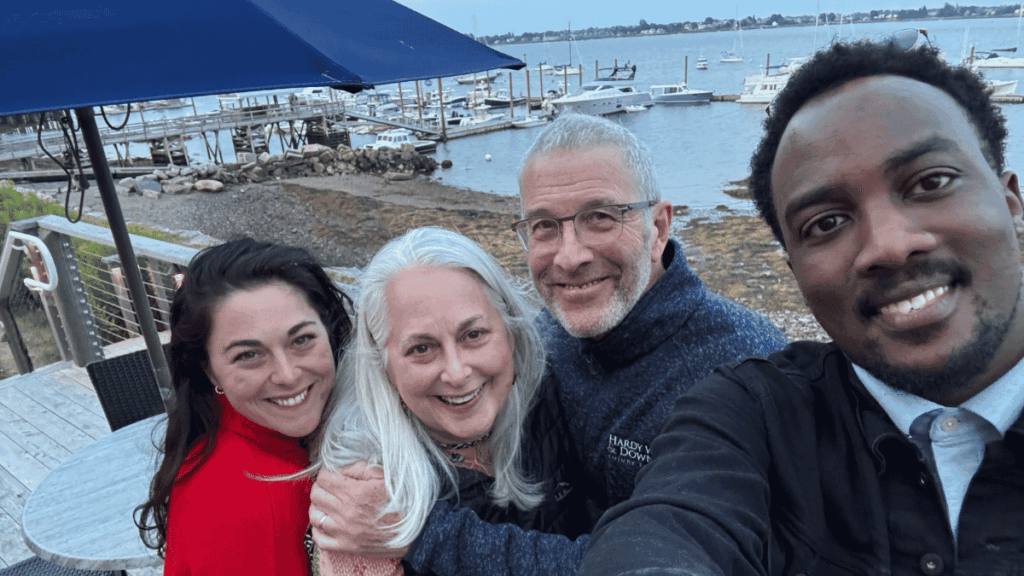
Jessie Tepler-Mujambere was almost there. The 28-year-old was driving north through New Hampshire on Wednesday, on his way to start a new life in Canada, when he was pulled over in the small town of Colebrook, about 10 miles from the border.
That traffic stop ended with him in federal immigration custody for two days.
Tepler-Mujambere is the adopted son of Maine State Sen. Denise Tepler, a Democrat from Topsham. On Friday, he was driven to the border by an immigration agent and crossed into Canada.
How a Traffic Stop Led to ICE
The Colebrook Police Department stopped him on Wednesday afternoon, October 28. According to the Department of Homeland Security, he was pulled over for speeding.
Colebrook police take part in a federal program known as 287(g). Under these agreements, local officers can question people they suspect are in the country illegally and turn them over to Immigration and Customs Enforcement. That’s what happened here. At 4:37 p.m., he texted his family that Colebrook police had arrested him.
According to the Bangor Daily News, he told officers that his asylum case was still pending, that he was heading to Canada, and that he had paperwork to prove it.
Over the next two days, he was moved between the Strafford County Jail in Dover and an ICE field office in Manchester.
His Story
Tepler-Mujambere was born in Burundi and came to the U.S. as a teenager on a visa. His family says he was brought to Maine by his biological father and left at a shelter. The Teplers took him in when he was 16 and later adopted him.
He applied for asylum, which allowed him to get a work permit. He graduated from Mt. Ararat High School, earned an associate degree and worked in health care. But earlier this year, his work permit expired and wasn’t renewed.
He had a way out. His adoptive father, Sheldon Tepler, was born in a refugee camp in Montreal and became a Canadian citizen a few years ago. Through him, Tepler-Mujambere was approved for Canadian citizenship in July. He was carrying his Canadian passport when he was stopped.
What DHS Says
DHS says Tepler-Mujambere entered the U.S. on a visa in November 2014, overstayed it, and that his legal permission to be in the country ran out in May 2015. The agency says a pending asylum application “does not confer legal status in the United States.”
DHS also says he requested what it calls “incentivized departure” to Canada.
Sen. Tepler has said she sees “a real racist element to the enforcement now.” DHS called claims that it racially profiles people “disgusting, reckless, and categorically FALSE.”
What His Family Says
His adoptive mother questioned the cost of holding someone who was already leaving the country. “The taxpayers paid for his last two nights in a county jail in New Hampshire,” she told the Bangor Daily News.
Maine Congresswoman Chellie Pingree, whose office helped the family track the case, put it more bluntly: “What, exactly, did this accomplish?”
His sister, Maya Tepler, said he seems to be doing well, and called his experience “a best-case scenario for a worst-case scenario.”
The Colebrook Police Department did not respond to requests for comment from several news outlets.
A Line Between Two States
The case highlights how much the rules can change when you cross a state line. In New Hampshire, some local police departments work directly with ICE through 287(g) agreements. In Maine, a new state law that took effect this year makes those agreements illegal.
That means the same traffic stop could lead to very different outcomes depending on which side of the state line it happens on.
What Drivers Should Know About Traffic Stops
Whatever your situation, the basics of a traffic stop are the same. Pull over safely, keep your hands where the officer can see them, and have your license, registration and insurance ready.
If you have questions about your rights during a traffic stop, especially in a town with a 287(g) agreement, it’s worth talking to a licensed attorney or a legal aid organization in your state ahead of time.
Sources